
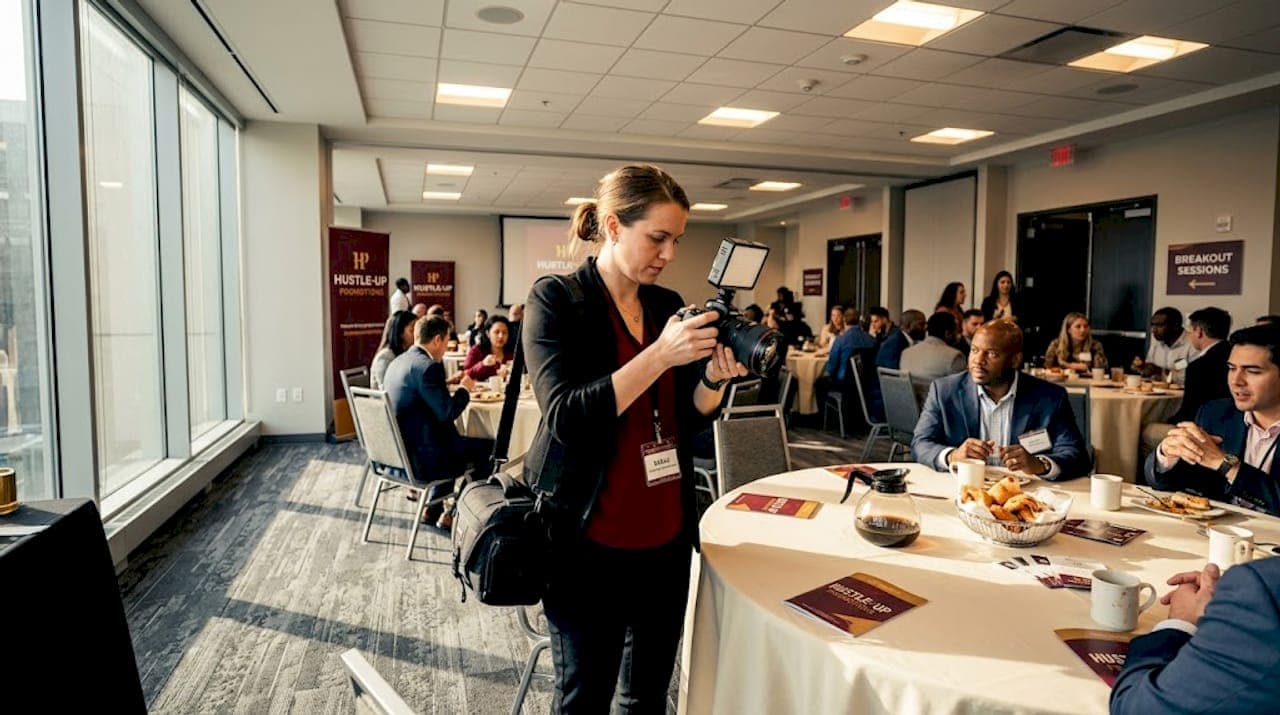
Your corporate event is a live marketing moment. Every keynote, handshake, award presentation, and networking conversation is a potential asset for your brand. But when the wrong photographer shows up, or when you skip the planning steps that matter most, failing to capture engaging moments can undermine your entire post-event marketing strategy. This guide walks you through every step of the hiring process, from defining your goals to coordinating day-of logistics, so your next event produces photos that actually work hard for your business.
Table of Contents
- Clarifying your goals and needs
- Vet photographers: What to look for
- Interviewing and selecting your photographer
- Coordinating logistics and maximizing results
- Why most corporate event photography fails and how to do better
- Ready to elevate your next Pittsburgh event?
- Frequently asked questions
Key Takeaways
| Point | Details |
|---|---|
| Plan with specific goals | Defining your event’s key objectives ensures you get usable marketing assets from your photos. |
| Prioritize reliability and fast delivery | Dual cameras and rapid photo turnaround are must-haves for impactful corporate events. |
| Vet for local knowledge | Local photographers offer cost benefits and familiarity with Pittsburgh venues, boosting results. |
| Clarify logistics early | Coordinate shot lists, access, and deliverables in advance to avoid day-of hiccups. |
| Think marketing-first | Focus on capturing moments that will serve post-event marketing, not just traditional event documentation. |
Clarifying your goals and needs
Once you understand the stakes of quality photos, start by sharpening your event objectives. Before you search for a single photographer, you need to know exactly what you want the photos to do. Are you building brand awareness? Showcasing leadership? Creating social media content that keeps your audience engaged for weeks after the event? These are very different goals, and they require different approaches.
Here are the most common photography goals for corporate events:
- Brand exposure: Wide shots of branded signage, stage setups, and sponsor displays that reinforce your company's identity
- Leadership portraits: Clean, professional headshots and candid leadership moments that humanize your executives
- Social media coverage: High-energy, emotionally engaging images that perform well on LinkedIn, Instagram, and company newsletters
- Internal documentation: Photos for internal reports, board presentations, and employee communications
- Press and PR assets: High-resolution images formatted for media outlets and press releases
Your event type shapes everything. Tailor shot lists to event type, leaning toward more portraits for galas and more candids for networking sessions. A formal awards gala calls for polished, well-lit portraits and dramatic stage shots. A casual networking mixer needs spontaneous, genuine moments that feel alive and energetic. A multi-day conference requires both: keynote coverage, breakout sessions, exhibit hall energy, and everything in between.
Once you know your goals, build a creative brief. Think of it as a short document that outlines the deliverables your marketing team actually needs. Not just "photos from the event," but specific assets: a hero image for the post-event email, five LinkedIn-ready candids, three executive portraits, and a wide room shot for the annual report. Working backwards from those deliverables keeps your photographer focused on what matters.
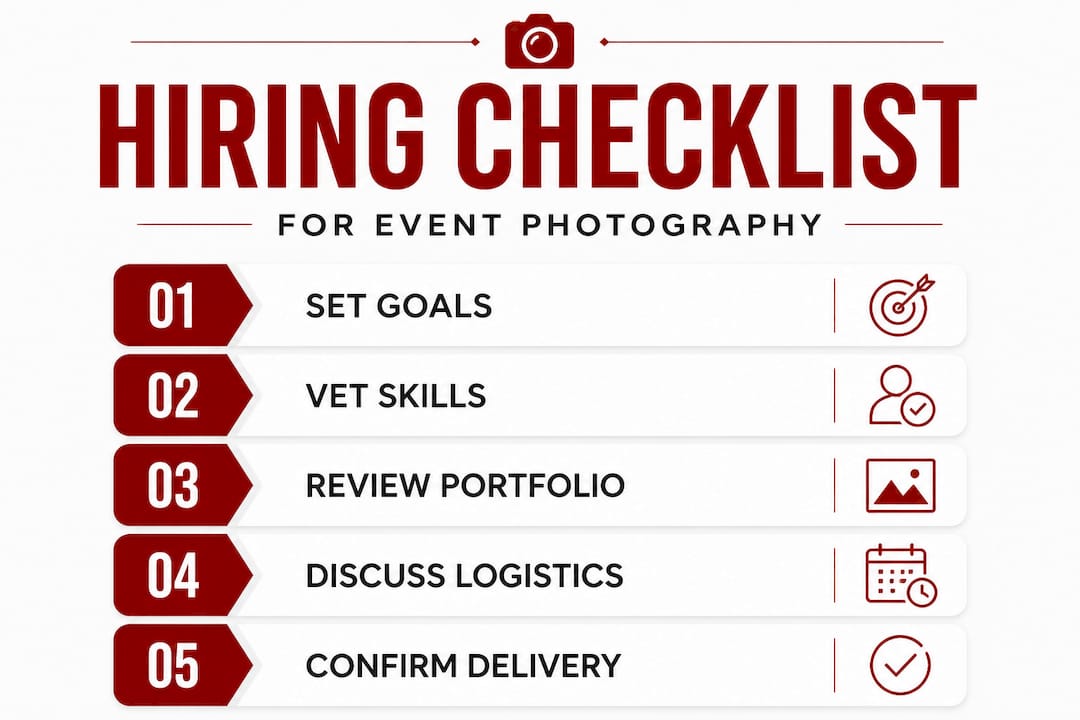
Pro Tip: Before your first photographer conversation, sit down with your marketing team and ask, "What images do we wish we had from our last event?" That answer becomes the foundation of your shot list.
You can find local or national photographers who specialize in corporate work, but defining your goals first means every conversation you have will be sharper and more productive.
Vet photographers: What to look for
With your needs defined, begin researching and comparing actual photographers. This is where most event planners rush, and it costs them. A great headshot photographer is not automatically a great event photographer. The skills are genuinely different, and corporate events demand a very specific set of capabilities.
Here are the essential criteria to evaluate:
- Corporate event experience: Look for portfolios that show events similar in size and tone to yours. A photographer who shoots galas every weekend thinks differently than one who primarily does product photography.
- Portfolio quality: Look for consistent exposure, sharp focus in low-light settings, and images that tell a story rather than just document a room.
- Liability insurance: Any professional working at a corporate venue should carry general liability insurance. This protects you and your organization if something goes wrong.
- Client reviews: Look for reviews that mention reliability, communication, and turnaround speed, not just image quality.
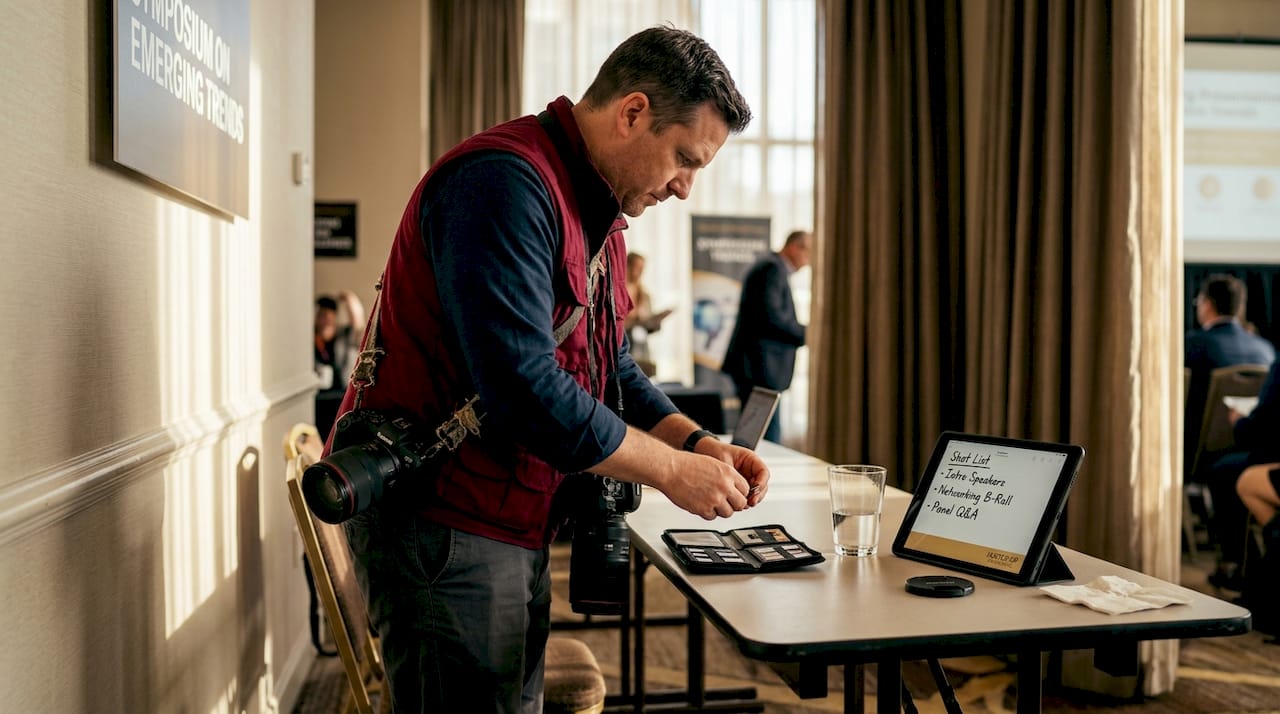
- Backup systems: Equipment fails. Ask whether they carry backup camera bodies, lenses, and memory cards.
Dual camera setups and fast delivery are becoming industry standards in 2026, ensuring reliability and enabling real-time social media engagement. This is not a luxury. It is a baseline expectation for any photographer serious about corporate work.
Here is a quick comparison to help you decide between national firms and local professionals:
| Factor | National photography firms | Local photographers |
|---|---|---|
| Consistency across cities | High, standardized workflows | Varies by individual |
| Local venue knowledge | Limited | Strong |
| Pricing | Often higher overhead costs | Generally more competitive |
| Communication | May route through account managers | Direct access to the shooter |
| Flexibility | Less adaptable to last-minute changes | More responsive and agile |
| Community relationships | Minimal | Established local network |
Understanding costs and consistency by location helps you make a smarter decision based on your specific event footprint. If you run events across Pittsburgh, Cleveland, Erie, and Harrisburg, a local team with regional reach often delivers the best of both worlds: competitive rates and real familiarity with your market.
A fast turnaround is not just convenient. When social media-ready images are delivered within 24 hours of your event, your post-event engagement spikes while the excitement is still fresh. That momentum is hard to recreate three days later when the gallery finally arrives.
Interviewing and selecting your photographer
Shortlisted a few candidates? Now ensure your top pick checks every box. The interview stage is where you move beyond portfolios and start evaluating the person behind the camera. Great photographers are communicators, problem-solvers, and collaborators. You want someone who asks smart questions, not just someone who shows up and shoots.
Here are the key questions to ask every candidate:
- "Have you photographed events similar to mine?" Ask for specific examples and request to see the full gallery from a comparable event, not just the highlight reel.
- "What is your workflow on event day?" A seasoned pro will describe how they move through the room, manage lighting challenges, and stay ahead of the schedule.
- "What happens if your equipment fails?" The answer should be immediate and confident. Dual cameras, backup memory cards, and a plan for every scenario.
- "How do you handle image delivery?" Get specifics: how many edited images, in what format, by what deadline.
- "Who owns the photos?" Usage rights matter enormously for marketing. Confirm that your organization has full rights to use the images across all channels without additional licensing fees.
When reviewing a proposal, look beyond the price. Evaluate the delivery timeline, the number of final edited images included, the file formats provided, and whether the contract specifies usage rights clearly. A proposal that is vague on these points is a red flag.
Photographers offering real-time delivery and interactive booths are responding to 2026's expectation for immediate content. If your event has a social media component, ask whether the photographer can deliver a curated selection of images within hours of the event ending.
Evaluating fit goes beyond technical skills. Does the photographer communicate quickly and clearly during the quoting process? Do they seem genuinely curious about your event goals? Are they flexible when you ask for adjustments to the scope? These behaviors during the hiring process are strong predictors of how they will perform on event day.
Pro Tip: Send a quick email to each finalist with a hypothetical scenario, something like, "Our keynote speaker is running 20 minutes late and the lighting in the ballroom just changed. How would you handle it?" The speed and quality of their response tells you everything about how they handle pressure.
Coordinating logistics and maximizing results
Once you've locked in your photographer, the final step is seamless execution and capturing those powerful moments. Booking is only half the job. The difference between good event photos and great event photos often comes down to the coordination that happens in the days before the event.
Here is a pre-event coordination checklist to run through with your photographer:
- Confirm venue access: Establish what time the photographer can enter the venue, where they can set up, and whether there are any restricted areas.
- Share the final shot list: Send a detailed, prioritized list of must-have shots. Include names and titles of key people who need to be photographed.
- Identify a day-of contact: Designate someone on your team who can guide the photographer throughout the event and flag important moments in real time.
- Discuss lighting conditions: Walk through the venue layout and flag any challenging lighting situations, like a dark cocktail hour space or a stage with harsh spotlights.
- Set delivery expectations in writing: Confirm the timeline for social-ready images, the full edited gallery, and any raw file delivery if applicable.
- Clarify privacy and consent: If any attendees have requested not to be photographed, communicate that clearly. For events with sensitive business discussions, establish which sessions are off-limits.
"Detailed planning and redundancy strategies reduce risk and improve outcomes." Treat your pre-event photographer briefing with the same seriousness as your AV check or catering walkthrough. It is not optional. It is what separates a smooth shoot from a chaotic one.
Detailed planning improves outcomes consistently across every type of corporate event. The planners who treat the photographer as a full partner in the event experience always walk away with stronger assets than those who treat photography as an afterthought.
Timing your deliverables strategically also matters. Social-ready images within 24 hours let you capitalize on post-event energy. A full edited gallery within 3 to 7 days gives your marketing team time to build out longer-form content like recap blog posts and email campaigns. Build these deadlines into the contract so expectations are crystal clear on both sides.
Why most corporate event photography fails and how to do better
Here is an honest take that most guides skip over: the biggest mistake in corporate event photography is not hiring a bad photographer. It is treating photography as a checkbox instead of a marketing strategy.
We see it constantly. An event planner books a technically skilled photographer, hands over a generic shot list, and walks away with 400 images that look fine but do nothing for the brand. The photos sit in a shared drive. The marketing team uses two of them. The event is forgotten within a week.
Prioritizing shots you can use in post-event marketing delivers more long-term value than a high photo count. Quality and intentionality beat volume every single time. A single powerful image of your CEO connecting with a client on the event floor is worth more than 50 wide shots of a half-empty room.
The overlooked high-impact shots are almost always the same ones: a genuine laugh between two attendees, a speaker's face in the moment they land a big point, the energy of a crowd reacting in real time. These are the images that stop people from scrolling. They are also the hardest to get without a photographer who understands your goals deeply.
The solution is collaboration. Bring your marketing team into the shot list creation process. Ask them what content gaps they are trying to fill. Are they building a case study? They need images that tell a story of connection and problem-solving. Are they recruiting new talent? They need images that show culture and energy. That context transforms a generic shot list into a targeted content strategy.
Thinking about event consistency and ROI means recognizing that photography is not just a line item on your event budget. It is an investment in content that keeps working for your brand long after the event ends.
Ready to elevate your next Pittsburgh event?
If you're ready to put these strategies into action, partnering with local specialists makes all the difference. Knowing what great corporate event photography looks like is one thing. Having a team that shows up creative, prepared, and ready to exceed your expectations is another.
We are the Pittsburgh event photography experts who bring energy, professionalism, and a genuine passion for capturing moments that matter. From photo booths that get your guests talking to full-service event photography that delivers marketing-ready assets, we cover every angle. We serve Pittsburgh, Harrisburg, Cleveland, and Erie, so wherever your next event happens, we are ready to be there. Reach out today and let's start building the shot list that will make your next corporate event unforgettable.
Frequently asked questions
How far in advance should you book a photographer for a corporate event?
Book at least 2 to 3 months ahead to secure the best talent and allow time for detailed planning, shot list creation, and contract review. Popular photographers in markets like Pittsburgh and Cleveland fill their calendars quickly, especially during peak conference season.
What's the average turnaround time for event photos in 2026?
Many photographers now offer social media-ready photos within 24 hours, with full edited galleries delivered within 3 to 7 days. Fast turnaround is increasingly a standard expectation, not a premium add-on.
Should you choose a local photographer or a national company?
Local photographers often provide better rates and stronger knowledge of local venues, while national companies offer more standardized consistency across multiple cities. For most single-city corporate events, a local professional with strong corporate experience is the better value.
What logistics should be coordinated with a photographer before the event?
Confirm venue access times, finalize the shot list, identify a day-of point of contact, and set delivery expectations in writing before the event date. Clear pre-event communication prevents the most common day-of problems.
Why is dual camera redundancy important for event photographers?
Dual cameras ensure reliability so that a technical failure with one body does not mean missed shots during critical moments. For once-in-a-moment events like award ceremonies or executive keynotes, redundancy is not optional.