
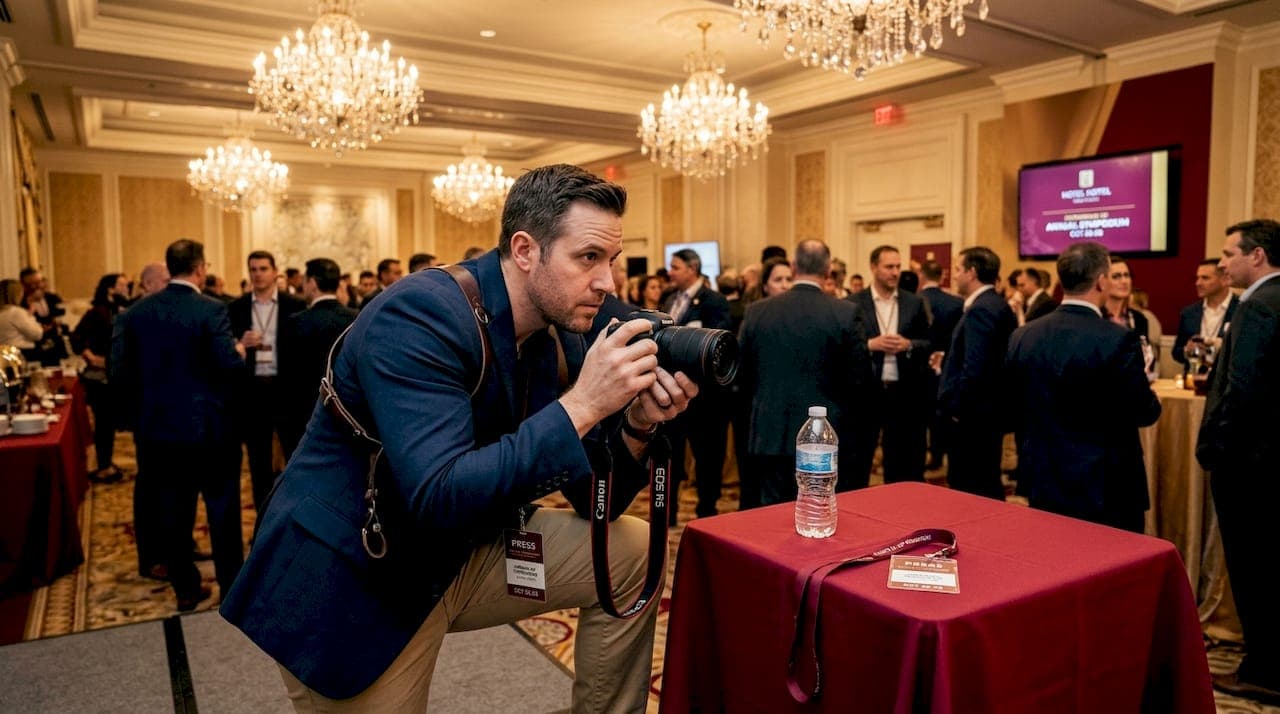
Most businesses treat event photography as an afterthought. You book the venue, arrange the catering, confirm the speakers, and then, somewhere near the bottom of the list, you think about hiring a photographer. That mindset is costing you. The images captured at your corporate events are not just documentation. They are strategic assets that fuel your marketing campaigns, strengthen your brand identity, attract top talent, and tell your company's story to the world. Understanding exactly what a corporate event photographer does changes how you plan, budget, and execute every event going forward.
Table of Contents
- Defining the corporate event photographer role
- Core responsibilities: What corporate event photographers deliver
- Hero assets vs. context and culture shots
- Choosing the right photographer: Questions and checklist
- Why strategic event imagery is a brand superpower
- Connect with Pittsburgh's leading event photography experts
- Frequently asked questions
Key Takeaways
| Point | Details |
|---|---|
| Strategic event photography | Professional photographers capture assets that drive marketing, PR, and internal communications value. |
| Hero and culture shots | Balancing 'hero' images and candid moments makes event imagery versatile and impactful. |
| Collaboration boosts results | Working closely with your photographer ensures all essential moments and branding are captured. |
| Choose with expertise | Selecting a photographer experienced in Pittsburgh corporate events increases quality and relevance. |
Defining the corporate event photographer role
Corporate event photography is a specialized discipline, and it is worth understanding what separates it from general photography work. According to Cvent's event photography guide, a corporate event photographer is a professional hired to document business-focused events, including conferences, seminars, product launches, awards ceremonies, and networking gatherings, to produce imagery usable for corporate marketing, PR, internal communications, and social media.
That definition is important because it shifts the frame entirely. This is not about capturing pretty pictures. It is about producing a library of professional images that serve specific business purposes. Every shot has a potential destination, whether that is your company's LinkedIn page, a press release, an internal newsletter, or a recruitment brochure.
The range of events that fall under this category is broad:
- Annual conferences and summits where industry leaders gather to share ideas
- Product launches that need compelling imagery to support media coverage
- Awards ceremonies celebrating employee achievements and company milestones
- Networking events that showcase your company culture and community involvement
- Trade shows and expos where branded visuals reinforce your presence
- Training seminars and workshops that demonstrate investment in your team
- Executive retreats and leadership meetings that communicate organizational strength
"A corporate event photographer isn't just someone with a camera. They're a visual storyteller who understands your business goals and captures images that move those goals forward."
When you work with a team that delivers an event experience in Pittsburgh built around your brand, you are investing in imagery that works for you long after the event ends. The right photographer understands your audience, your messaging, and your visual identity before they ever pick up a camera.
Core responsibilities: What corporate event photographers deliver
Understanding the role is one thing. Knowing exactly what a professional delivers, from pre-event planning through final image delivery, is where things get practical. Good corporate event photography combines technical preparedness with planning, briefing, a shot list of must-have deliverables, and the ability to capture both planned moments and spontaneous candid interactions without missing key stakeholder images.
Here is how the process typically unfolds:
- Pre-event briefing and discovery. The photographer meets with you to understand the event's purpose, key stakeholders, brand guidelines, and desired outcomes. This conversation shapes every decision made on the day.
- Shot list development. Together, you build a prioritized list of must-have images. Think of it as your visual agenda. Keynote speaker on stage, CEO presenting an award, team photo with leadership, branded signage, crowd engagement shots.
- Venue scouting. Experienced photographers visit the venue in advance to assess lighting conditions, identify the best angles, and plan movement throughout the space. This eliminates surprises on event day.
- Day-of execution. The photographer arrives early, sets up equipment, and positions themselves to capture every key moment. They move fluidly through the event, staying out of the way while staying on top of every shot.
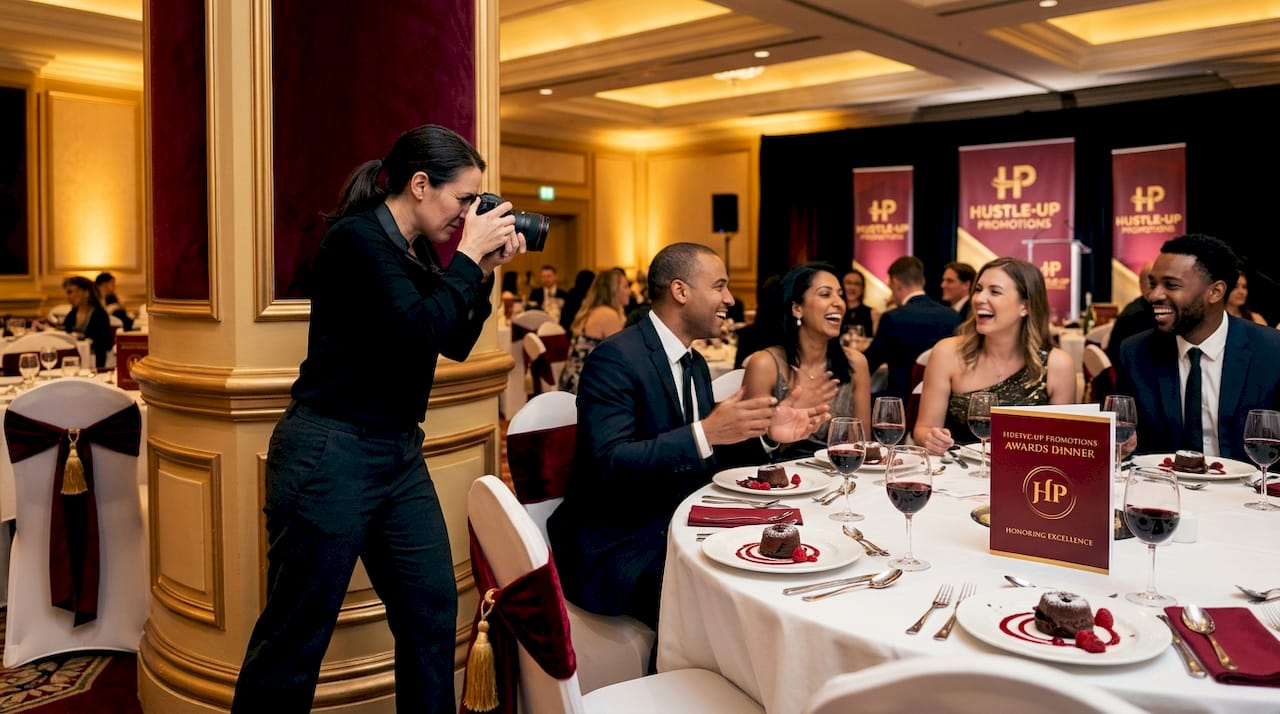
- Capturing candid interactions. Some of the most powerful corporate images are not posed. A genuine laugh between colleagues, a handshake after a deal, a speaker connecting with the audience. These moments tell a human story.
- Post-event editing and delivery. Images are culled, color-corrected, and delivered in formats optimized for your intended use, whether that is web, print, or social media.
Pro Tip: Always request a mix of wide establishing shots, medium shots of groups and interactions, and tight close-ups of speakers and branded details. This variety gives your marketing team maximum flexibility when creating content across different channels.
The ability to capture spontaneous moments without losing focus on the planned shot list is a genuine skill. It requires experience, situational awareness, and a calm, professional presence that does not disrupt the energy of your event.
Hero assets vs. context and culture shots
Not all event photos serve the same purpose. A practical way to think about your image library is to divide it into two categories. Hero assets and context shots serve different but equally important roles: hero assets are your marketing and PR powerhouses, while context and culture shots tell the deeper story of your organization.
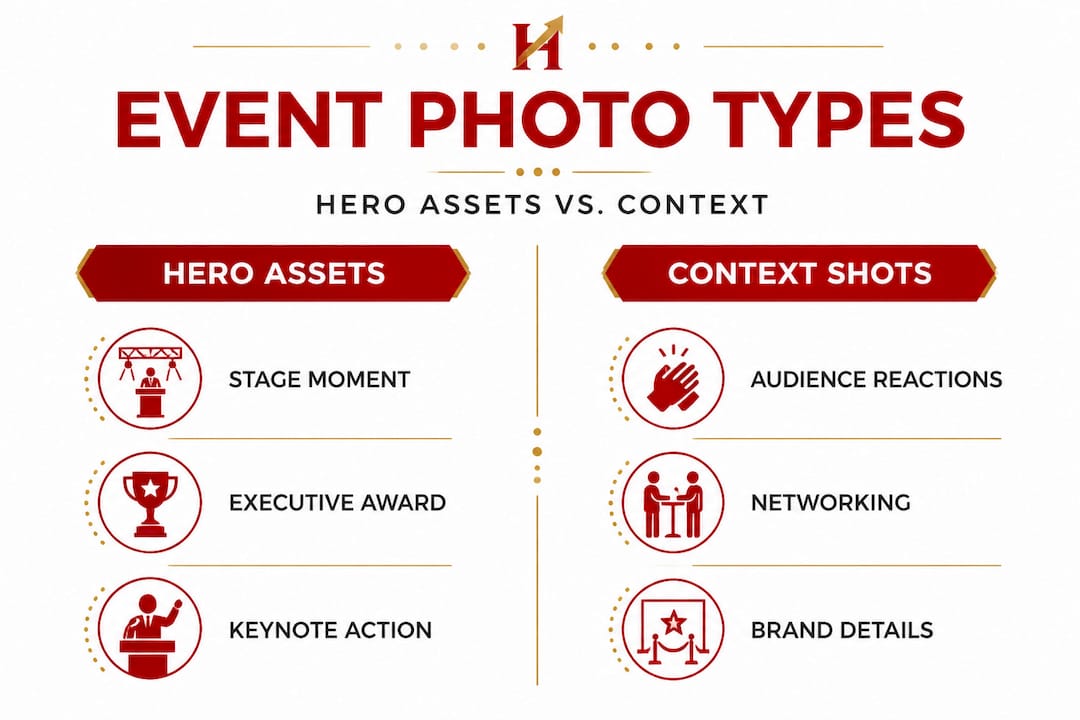
| Image Type | Examples | Primary Use |
|---|---|---|
| Hero assets | Keynote speaker on stage, executive presenting award, branded stage backdrop | Press releases, website, LinkedIn, marketing campaigns |
| Context shots | Networking interactions, attendees engaged in sessions, candid laughter | Social media, recruitment content, internal newsletters |
| Culture shots | Team celebrations, behind-the-scenes moments, branded merchandise in use | Employer branding, company culture pages, onboarding materials |
| Detail shots | Branded signage, event decor, product displays | Event recaps, partner communications, trade publications |
Understanding this breakdown helps you brief your photographer more effectively and ensures your image library covers every communication need.
Here is why this matters for your bottom line. A single well-executed corporate event can generate imagery that powers your content calendar for months. Consider what you can do with a strong collection of hero and context shots:
- Social media content for LinkedIn, Instagram, and Facebook across multiple weeks
- Blog posts and event recap articles that drive website traffic
- Email marketing campaigns featuring real people from your organization
- Recruitment materials that show prospective employees what your culture looks like
- Annual reports and investor presentations that communicate organizational vitality
- Media pitches and press releases supported by professional imagery
The key insight is repurposability. When you invest in branded assets in corporate events, you are not paying for one day of photography. You are building a content library that generates returns across every channel your business operates in.
One stat worth keeping in mind: content with relevant images gets significantly more engagement than text-only content across virtually every digital platform. Your event is happening anyway. The only question is whether you capture it in a way that maximizes its value.
Choosing the right photographer: Questions and checklist
Knowing what you need is half the battle. Finding the right professional to deliver it is the other half. Not every photographer who takes great portraits or wedding photos is equipped to handle the fast-paced, high-stakes environment of a corporate event. You need someone with specific experience, a collaborative working style, and a proven track record with business clients.
Here is a practical checklist for evaluating your options:
| Evaluation Criteria | What to Look For |
|---|---|
| Corporate event portfolio | Examples of conferences, awards, and business events specifically |
| Shot list experience | Ability to collaborate on and execute a detailed must-have list |
| Venue familiarity | Experience with local venues or willingness to scout in advance |
| Turnaround time | Clear timeline for image delivery after the event |
| Licensing and usage rights | Full rights for marketing, PR, and internal use |
| Equipment backup | Redundant cameras and lighting for high-stakes events |
| Client references | Testimonials or contacts from previous corporate clients |
When you are interviewing photographers, ask these specific questions:
- Can you walk me through how you prepare for a corporate event you have not covered before?
- How do you handle low-light situations in conference rooms or ballrooms?
- What is your process for developing a shot list with a client?
- How do you ensure you capture key stakeholders without being disruptive?
- What file formats and resolutions do you deliver, and how do you organize the final gallery?
- Have you worked with companies in our industry or at similar events?
Cvent recommends working with the client to develop a must-have photo list, preparing a shot list, and visiting the venue if possible. They also specifically warn against missing spontaneous moments, which is a real risk when photographers focus too heavily on posed shots.
Pro Tip: Ask to see a full gallery from a past corporate event, not just a highlight reel. A curated portfolio shows you the best five shots. A full gallery shows you how the photographer handles the entire arc of an event, including the slower moments and the transitions between sessions.
When evaluating local options, Pittsburgh event expertise matters. A photographer who knows the venues, understands the local business community, and has relationships with event planners in the area brings practical advantages that a generalist simply cannot offer.
Why strategic event imagery is a brand superpower
Here is an opinion you might not hear often: most companies dramatically underspend on event photography relative to what they spend on the event itself. They will invest tens of thousands of dollars in a conference, then hire the cheapest photographer available or skip professional coverage entirely. That is a significant strategic error.
Think about the math. Your event costs real money. Venue, catering, speakers, travel, accommodations, printed materials. That investment is designed to create an experience that moves your business forward. But the event itself lasts one day. The images from that event can work for you for years.
Strong event imagery does something that most marketing content cannot. It shows real people, in real moments, doing real things that matter to your organization. That authenticity is genuinely rare in a world saturated with stock photos and AI-generated visuals. When a prospective client sees your team genuinely engaged at a leadership summit, or a prospective employee sees your company culture captured in a candid moment of celebration, those images communicate trust in a way that no copywriter can manufacture.
There is also a compounding effect that most businesses miss. When you build a library of professional event imagery over multiple years, you create a visual narrative of your organization's growth. You can show where you started, the milestones you have celebrated, the people who have contributed to your success. That narrative has real value in investor relations, media coverage, and brand positioning.
The businesses that treat corporate event impact as a strategic priority are the ones whose brands feel alive and authentic online. They are the companies whose LinkedIn posts get real engagement, whose recruitment pages attract real applicants, and whose marketing materials feel human rather than corporate. It is not magic. It is intentional investment in quality imagery, executed consistently over time.
The uncomfortable truth is that your competitors are either doing this well or they are not. If they are, you are already behind. If they are not, this is your opportunity to build a visual brand advantage that is genuinely difficult to replicate.
Connect with Pittsburgh's leading event photography experts
Your next corporate event deserves more than a last-minute photographer booking. It deserves a creative partner who shows up prepared, understands your brand, and delivers images that work hard for your business long after the event wraps.
At Hustle-Up Promotions, we specialize in creating unforgettable event experiences for businesses across Pittsburgh, Harrisburg, Cleveland, and Erie. We understand what corporate planners need because we have worked alongside them at conferences, award ceremonies, product launches, and networking events across the region. When you book an event photographer with us, you are getting a team that arrives creative, prepared, and genuinely invested in your success. Let's build something your brand can use for years to come. Reach out today and let's talk about your next event.
Frequently asked questions
What makes corporate event photography different from regular photography?
Corporate event photography focuses on capturing strategic assets usable for marketing, PR, and business communications rather than generic images. According to Cvent, a corporate event photographer is specifically hired to produce imagery for marketing, PR, internal communications, and social media.
What types of events need a corporate photographer?
Conferences, seminars, product launches, awards ceremonies, and networking gatherings all benefit from professional photography coverage. Cvent notes that corporate event photography includes key speakers, award presentations, branded signage, networking interactions, and group shots of leadership teams.
Why should I collaborate on a shot list with the photographer?
A shot list ensures every critical moment and key stakeholder is captured, giving you the specific deliverables your business needs. Cvent recommends developing a must-have photo list with the client while also leaving room to capture spontaneous moments.
Can event photos be reused for marketing and PR after the event?
Absolutely. High-quality event photos are versatile assets that serve marketing, PR, and internal branding across many channels for months or even years. Cvent confirms that clients can repurpose the same event imagery across social media, PR, and internal communications.